![DSC01425[1].jpg](http://pic.pimg.tw/jm4331/1324018983-65789285.jpg "DSC01425[1].jpg") 武術氣功的「練」與「用」
武術氣功的「練」與「用」
----- 本文是總幹事在 2011 年 11 月於長洪武學系統三段檢定
所提出的論文,關於氣功練習的一些體驗,特別刊出供
大家參考,或許透過這篇文章可以解開各位在氣功練習
上的一些問題和避免練習上浪費的一些無效時間。
1. 前 言
氣功的鍛練在長洪武術系統裏佔著非常重要的地位,
從
陳總教練所編著之「
武術的生命力」一書中提出「氣功」是武術的「生命力」即可看出,
因此對於武術氣功的教學也列為年度大事,於年度總館特別班中要花相當多的時間來教學;
筆者從西元 2000 年開始接觸氣功課程,從基礎、進階到高階氣功迄今十年來可以說未曾間斷,
然而有很長的一段時間對於這些單純的氣功動作要如何應用在「套路」與「實戰」中感到迷惑,
以致於每次練習時自認為功力不足、體驗不夠,只能乖乖地、笨笨地反覆執行這些動作,
直到
2009 年 上完年初的高階氣功班之後才有點開竅,在氣功的應用方面稍微有一點點體會,
也開始突破以往的迷思,能夠將武術氣功的「練」與「用」之間的鴻溝接上,
並據以改變自己的許多練習的方式和動作。
實際上,「
氣」是一種「
感覺」、一種「
生命」,
氣功練習的動作之所以簡單,主要是讓練習者透過這些單純的動作來練出「感覺」、熬出「生命」,
而其重點是在這些動作裏
---
----- 學到了什麼?
----- 練到了什麼?
----- 感覺到了什麼?
jm4331 發表在 痞客邦 留言(0) 人氣(1,707)
氣功心得[6]
俗話說:「書到用時方恨少」,
同樣地 :「功到練時方恨淺」,
氣功領域,真的是越練越感覺自己的不足,
今年,我全部再回頭練基本面,一方面持續修正問題,另一方面則用來加強「馬力」,
中高級的氣功我連碰都不敢奢望去碰它,底子不夠厚啊!沒辦法。
現在將這一段時間的體會跟大家分享:
![滿月圓[調]05.jpg](http://pic.pimg.tw/jm4331/48d365d3a83b9.jpg "滿月圓[調]05.jpg")
在瀑布旁練氣功效果最棒 ! ↑
01. 基本氣功的練習可以當成是「鬆」、「開」、「鬆」的過程。
02. 上列第一步「鬆」是上課中一再強調的「全身放鬆」,這是進入氣功練習的基本要求,
上列第二步「開」是長洪武術修練的核心要點「開三關九節」,「開」才能貫通氣息,
上列第三步「鬆」是「再鬆」、「細部的鬆」,它是微調的階段,特別是「肩」與「腰跨」。
03. 自從今年 6 月被陳總教練糾正肩部太緊的問題之後,我都一直在調整肩部的放鬆,
這是一件不容易的事情,但非過這一關不可,有時候你認為已經放鬆了,其實還早!
04. 不要說練氣功時要放鬆,有時候連坐在電腦前打字就可以發現兩肩是聳的、吊著的,
難怪很多人打字打久了肩膀會酸,長期下去甚至還會得到五十間的毛病,這就是沒有放鬆!
05. 肩膀會緊、會卡卡的往往是「想用力」或「誤認為要有力的感覺」,
這些錯覺將肩膀浮起、聳起,就會形成緊張、僵硬或是卡卡的現象。
![滿月圓[調]01.jpg](http://pic.pimg.tw/jm4331/1308795183-e1cb4cc1ecd4810f83320426aa34aa9a.jpg "滿月圓[調]01.jpg")
氣功練習是一種 「有意識」的動作 ↑
06. 練習氣功功法時,你是做「機械式」的動作?
還是做「思維式」的動作?
07. 「機械式」的動作是「無意識」的動作,
當你的意念跑掉時仍在做的動作便是如此,這是「體操」而已,無關「功力」。
08. 「思維式」的動作是「有意識」的動作,
當你的意念存在,於神思自然清晰的狀態下做所的動作便是如此,這是「練功」過程,
因為有意識,所以在做氣功功法動作時,會有「內視鏡」的效果,
向身體內部「掃描」,搜尋身體各部「結點」 [ 打結或糾結的部位 ] 所在加以調整,
透過不斷地調整修正,讓自己在全部正確的動作與狀態下來加強功力、提升功力。
09. 「不經掙扎,不知解脫;不經挫折,不知成功」
練習氣功的過程絕對是一種歷經掙扎與挫折的過程,
但只有歷經這些過程,才能享受到成功的果實,
這就是「玉不琢不成器、水不激無浪花」的道理,
如果有人跟你說他的功法是天上掉下來的或是夢中頓悟到的,那要離他遠一點!
10. 「體呼吸」練習的功效是在於:
10.1 讓氣息在丹田呼吸的「吸」與「吐」之間延綿不斷。
10.2 讓武術各項動作的練習與實戰「去除預備式」,
一方面免除多餘動作,一方面避免被對手看出動作破綻。
10.3 讓對手在聽勁時感受不到你的力量。
10.4 使對手的肢體與氣息跟你的結合在一起 [ 合力 ] ,以便達到作用的目的。
而為了達到上列功效,在基本「丹田呼吸法」第一組系列動作就已經要帶有這些訓練了。
11. 「丹田呼吸法」的每一組動作在「吸」與「吐」之間都不能斷,
否則都只是一次單向動作或是單循環動作,而不是連續動作,這就是類似「體呼吸」的訓練。
12. 練習氣功不要「捨本逐末」,
不論 '' 手掌發熱 '' 或是 '' 身體發熱 '' 都只是氣功練習的「附作用」,不是「真正目的」,
每個人體質不同,練習所產生的「附帶作用」也會不同,沒必要去追求「發熱、發麻」,
我們要練的是能產生「武術生命力的感覺」,也就是能提升力道和勁道的「氣感」,
練到會「發熱、發麻」,然而要用到時卻一點力道和勁道都沒有,那有什麼用?
因此,追求「氣感」才是真正的「本」,
「發熱、發麻」只是「末」------- 有,不錯! 沒有,So what ! --------- 。
jm4331 發表在 痞客邦 留言(1) 人氣(388)
氣功心得[5]日前與飛官志堅兄在家中泡茶論功,
兩人一面喝好茶,一面在客廳中比劃、揣摩、討論,
我們從早上 10:30 一直聊到下午 15:00 ,中午以便當簡單果腹,
四個多鐘頭的時間,我們賓主盡歡,茶泡得很爽,當然 '' 功 '' 也略有所得,
總幹事不藏私,一方面做筆記留紀錄,一方面分享諸位師兄嫂:
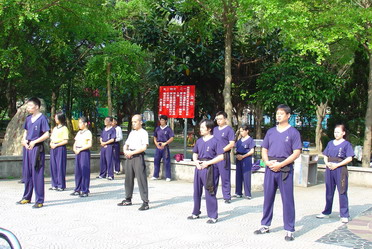
長洪武術中壢所學員藉 集訓活動 練習氣功 ↑
01. 基本丹田呼吸法練習的時候不要每次都是一次,應該是多次串起來只有一次。
02. 體呼吸練習第二、三式當手往兩側上提、延伸時,不要由身體兩側去拔身體
讓肌肉僵硬或造成聳肩的狀態,必須仍然保持身體肌肉的放鬆。
03. 練習氣功要能不斷提高「有效率」,有效率提高的話就能在工商繁忙的時候,
縮減練習時間而又可以有同樣的效果,假設之前練習 30 分鐘,有效時間只有
10 分鐘,有效率為 30 %強,如果將有效率提高到 50 % ,那只要練習 20
分鐘就能達到之前練習 30 分鐘的效果;請注意ㄜ!只要設法將有效率提高到
100%,那麼練習10 分鐘便會有 10 分鐘的效果。
04. 要提高氣功練習的「有效率」,「專注」是不二法門,專注是可以練習的,也
就是將自己「心中之猿止住、意裏的馬栓好」即可。
05. 練氣功沒有專注,只是在練「皮」 [也可以看成 '' 皮毛 ''],連「筋、骨」都沒
有;反之,有專注的時候,不但可練到「筋骨皮」,同時連「精氣神」都可以
有很明顯的感覺,所有動作會加強、加深、加重。
06. 開始練氣功是抓粗的、抓樹幹,也許 3 - 5年多,甚至 10 年多,這是「粗雕」;
後面練氣功是抓細的、抓枝葉,也許 3 - 5年後,甚至 10 年後,這是「微調」。
07. 當你練到完成 80 - 90 % 以上的「正確度」而感覺有效果時,就是開始要抓
細的或是抓枝葉的時候,困難度會更高,因為要作「微調」來修掉你更細微的
缺失或是錯誤。
08. 如何「微調」?很簡單,回頭參加最基本的課程或特別班,從源頭來檢視自己。
09. 每一年參加台北「氣功基礎班」,我就修掉自己練習的一些問題,使我不斷精進
,這就是志堅飛官說我這一兩年感覺跟以前不一樣的原因;以我個人的經驗,不
能忽略最基本的東西,「溫故而知新」是絕對的鐵則!
10. 「氣」是一種「感覺」、一種「生命力」;練習「氣功」的動作之所以很簡單,
主要是讓練習者去練「感覺」,重點是在這些簡單的動作裏 -----
----- 你學到了什麼?
----- 你練到了什麼?
----- 你感覺到了什麼?
練「空」或是練「實」?練「無」或是練「有」?全在「感覺」!!
藉「微調」來修掉氣功動作更細微的缺失
或是錯誤 ↑
jm4331 發表在 痞客邦 留言(1) 人氣(171)
氣功心得 [3]
最近,為了將在長洪武術系統所練的氣功作一個相互驗證,
特地去瀏覽林鬱文化出版由'' 張振興'' 先生所寫的「氣功發微」一書,
這本書大體上以談養身氣功為主,至於武術氣功的部份完全看不到,
而在書中後段所涉及的練功之後可以元神出竅、突破體框限制、雲遊宇宙太空等說法,
因總幹事程度太低,只能站在 '' 純欣賞 '' 的角度來看待,
我也很期待有這方面經驗的朋友,能夠跟我分享,因為這境界太高了。
我將該書可以供長洪練武師兄參考的部份條列如下,期望對各位的練習有所幫助:
1. 氣功的醫療作用是運用「放鬆」、「調息」、「意守」和「入靜」等方法來調養
「身」、「心」、「靈」,以便調整人體的精神[精]、氣血[氣]、元神[神],使增
強人體臟腑功能,從而達到治療目的。
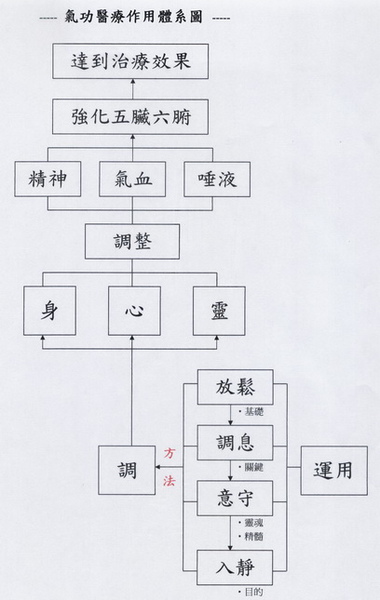
2. 氣功治病的基本原則:「放鬆」是基礎,「調息」是關鍵,「意守」是靈魂與精隨,
「入靜」是目的。
3. 「意念」活動就是大腦思維意識的定向活動,又是外在世界在腦中的反應所形成的
訊號,它的物質基礎就是大腦,所以意念活動就是大腦的功能;在氣功鍛鍊中,只
做動功,不用意念,就等於把氣功鍛鍊降低到了一般的體育活動。
4. 「意守」是意念集中到某一事物或某一部位,而達到對某一事物或某一部位的「專一」,
意守切忌過度,決不宜用意過重,固執死板,必須做到「似意非守、有意無意、勿忘勿助」
的原則;「意守」的醫療作用舉例如下:
4.1 意守病灶:意守身體有病的部位,達到治療的效果。
4.2 意守外景:練功時,意守名山大川 [ 磁場較強 ],可增強氣感;
意守某氣功大師,可借助其氣達到治療效果。
4.3 意守太空:採太空真氣,可通氣治療。
5. 練習氣功要領:
5.1 鬆靜自然。
5.2 動靜結合。
5.3 練養相兼。
5.4 意氣相依。
5.5 準確柔和。
5.6 循序漸進。
6. 鬆靜自然的境界:
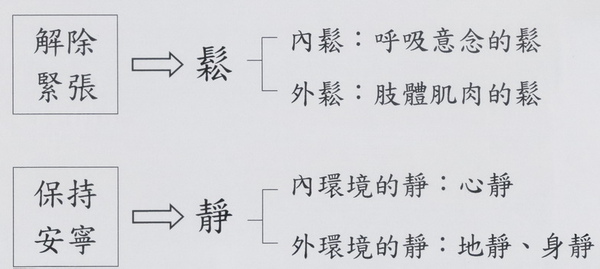
7. 「練」是一種過程,「養」是一種狀態。
jm4331 發表在 痞客邦 留言(0) 人氣(369)
jm4331 發表在 痞客邦 留言(1) 人氣(721)
氣功心得[2]
練習武術近 11 年,感覺最不好抓的就是「氣功」,因為武術套路的一些招式可以看得見,比較容易模仿,
唯有「氣功」是完全看不見、摸不著的心法,
雖有簡單動作引導,但是有沒有「氣」還要靠自己體會感覺,
而有了「氣」以後能不能帶出「功」,又是一大問題,
否則純粹是做做養生罷了,對於練武一點幫助都沒有,
武術名言所謂:「練拳不練功,到老一場空」,
從陳總教練所做的很多示範可以證明「
氣功」
確實是「
武術的生命力」,
從今年 [ 2009 ] 開始在氣功方面稍微有一點點體會,因此在上完台北進階氣功特別班之後,正式開始修練「
運氣法」,
我進階氣功「運氣法」足足連續聽了
總教練 7 - 8 年的課程,
但是一直自認為水準不到、氣感不強,以致不敢登其殿堂,
長期以來都一直停留在基礎的部份,
練習丹田呼吸、體呼吸和氣息控制法而已,說起來,我還算練得蠻勤快的,
平均每個禮拜至少練它 3 -4 次,每次 30 分鐘以上,
可是我應該是屬於起爐比較慢的一類,怎麼做氣感就是拉不太起來,
還好我並不氣餒,每年都參加各項氣功班,一點一滴的來調整修正,
也許上天疼憨人,熬了這麼多年後,總算給我開了一點竅,
在氣感稍微提升後,我今年更乘勝追擊,
每週至少練 5 次 ,每次增加到 1 - 1.5 個小時,
我期望在加強氣功的時間和密度之後,能夠拉高武術的層次和水準;
jm4331 發表在 痞客邦 留言(2) 人氣(1,086)
Nick氣功心得:2009 Chi Gong Level 2
------ 這是 Nick今年上台北總館氣功進階班之後的心得報告,
Nick 真的不簡單,從早年完全聽不懂國語,到慢慢可以意會,
現在不但會聽,而且會講,今年上過氣功進階班之後,
竟然可以將聽到這麼艱深的內容轉化成心得報告,
可見他在武術與氣功領域用功之深啊!讓我們佩服他吧!
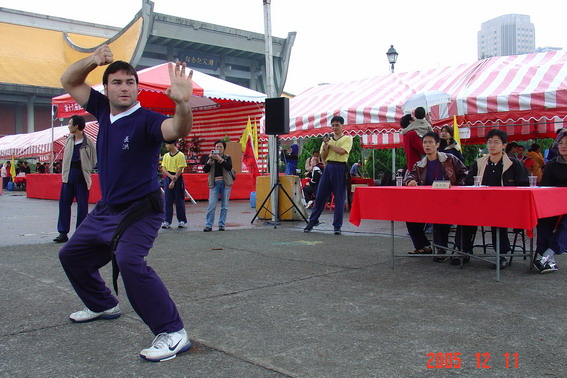
Nick 參加長洪盃比賽 ↑
In the three classes of second level chi gong,
the basic stance and body form were re-instructed at the beginning.
These are, the importance of emptying the body (han),
stabilizing the dan tien (wen ding), tilting the coccyx forward,
chin slightly tucked in,
and the tongue touching the roof of the mouth to regulate air velocity.
Emphasis is placed on these chi gong basics because they are the roots.
After refreshing students on the basics,
four concepts were introduced by Sifu Chen,
juan lang, an chi, zhen shen, and chui jing.
1. Juan Lang [捲浪法]
Like waves in the ocean, or waves of sound,
we can use our bodies as instruments to collect and process these waves.
Juan lang refers to the gathering of chi in a wave of breath.
Emphasis is placed on the inhale,
while the hands act like a tangible guide for breathing,
being raised in front of your body while breathing in,
from the dan tien to shoulder level.
Using the hands while focal breathing in chi gong,
helps to create a space mentally,
which then becomes second nature and then almost natural after years of practice.
When the hands are at shoulder level,
you should have filled your dan tien with the wave of chi,
seeing as juan lang is focused on the inhale.
The exhale is not forced, allowing the body to naturally empty,
of course still wen ding.
This lets the body digest the wave of chi that has been captured.
2.An Chi [按氣法]
The next lesson taught was on the concept of an chi.
This is almost the opposite of juan lang,
in so far as the inhale is not the focus, but rather the exhale.
In the exercises taught to us for developing out abilities to an chi, or press air,
we begin using a controlled inhale allowing our dan tien to fill with chi,
hands raised to shoulder level coinciding with our breath.
Then before exhaling one must an chi,
using a slight contraction of the diaphragm or dan tien,
your breath is forced or pressed,
allowing the transfer of energy in the body to become like a pneumatic press.
An chi, much like juan lang, is a mind space that needs to be developed,
using the muscles to awaken them,
and the focus of the mind to make a connection.
3. Zhen Shen [震身法]
Zhen sen is a beginning step to the higher levels of chi gong.
Here we were taught to inhale,
using the same hand motions as the first two lessons
with the hands rising in front of the body
allowing the dan tien to fill with chi.
Then when capacity is reached,
allow about eight to ten percent of controlled air out through the mouth,
and then a full contraction of the dan tien is performed,
with the goal being to create a pulse of energy.
This pulse at higher levels can be distributed and controlled as a strike, or in defense.
The road to mastering this is long and arduous,
as the contraction is using yet another connection
that we must make between our minds and out bodies,
and unless instructed and practiced, is seemingly impossible.
The zhen shen can be repeated numerous times on one breath.
It can also be performed with almost no air left in the dan tien or diaphragm,
a form of residual chi.
4. Chui Jing [催勁法]
Chui jing is the culmination of earlier lessons in chi gong.
Here the internal theories of chi gong are practiced and
the externalization of force becomes real.
The exhale here is focused upon,
as with an chi, the inhale is normal, of course with the proper stance and form.
When exhaling, chui jing’s goal is to allow the user to connect
the force or chi developed in one’s dan tien,
to be channeled to one’s extremities,
In theory if one follows the steps that have been instructed,
and remembers all the steps and have practiced almost religiously,
the result should be that our push with our hand should be
directly connected to our dan tien, and thus developing chi power.
jm4331 發表在 痞客邦 留言(1) 人氣(206)
功法與功力---功法不一定有功力
今天早上在社區空地練習氣功,
正當練習到一半時,突然從遠方傳來一陣陣很大的笑聲,
可以聽得出來是由一個人透過麥克風帶領一群人在''笑'',
我判斷應該是最近媒體上報導有人在推廣的「笑功」,
我不了解笑功的練法,也沒也資格加以評論,
但是我相信笑功絕對練不出武術上的「功力」,
如果不加以分析,外人一定會有所誤解:
「反正都是'' 功 '' 嘛,這個笑功比較好練、比較簡單。」
實際上,「功法」與「功力」是兩碼子的事情,
不論那一種門派,不管那一個系統,所有練功的方式,都可稱為「功法」,
而透過「功法」修練能在身體內部產生護體、外部產生抗敵的作用力,才可稱為「功力」,
我在 2007 / 11 / 18 --- 「氣功讓武術以實」的文章裡曾經提到氣功練習的幾個階段,
在沒有進入「運氣階段」的練習,根本無法練出任何功力的,
我們只能說這些練不出功力的功法叫「儲養氣息」,也就是一般所謂的「養生功」,
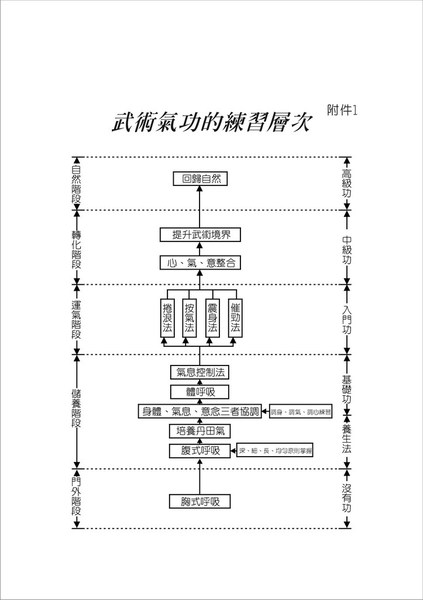
如果笑功的練習還是用胸式呼吸或者根本連氣息的培養都沒做到的話,
那很抱歉!他們連「養生功」都還稱不上,只能說他們是在做一種「動作」,
透過這種動作,「也許」能讓練習的人心情很好,而「心寬體胖」,自然身體變好,
現代人練功越來越「懶」,越來越怕吃苦,所以很多簡單的功法相繼推出,
我相信將來一定會有人推出「睡功」的!
可是我們必須認清一個事實「No pain , No gain 」,功力必須經過焠鍊才能得到,
功力不會從天上掉下來,因此輕輕鬆鬆、不努力付出是練不出功力的。
功力 必須經過焠鍊才能得到 ↑
P.S :有師兄提醒我:為何幫版面下的''氣功''打廣告,我要聲明那是別人打的,
跟我無關,剛好大家可以利用上面的系統圖來檢視此''氣功''班的定位,
面對氣功的神秘面紗,大家還是小心一點比較好! jm4331 發表在 痞客邦 留言(1) 人氣(123)
![處女瀑布04[調].jpg](http://pic.pimg.tw/jm4331/4adc8c8709fea.jpg "處女瀑布04[調].jpg")
![日月潭馬步[調].jpg](http://pic.pimg.tw/jm4331/1196350062.jpg "日月潭馬步[調].jpg")
![處女瀑布[調]01.jpg](http://pic.pimg.tw/jm4331/4adc2a6c319a0.jpg "處女瀑布[調]01.jpg")
![處女瀑布03[調].jpg](http://pic.pimg.tw/jm4331/4adc8bdd55d9a.jpg "處女瀑布03[調].jpg")
![蛇拳[調].jpg](http://pic.pimg.tw/jm4331/4a3897cadc2e1.jpg "蛇拳[調].jpg")

 長洪武術 (12)